
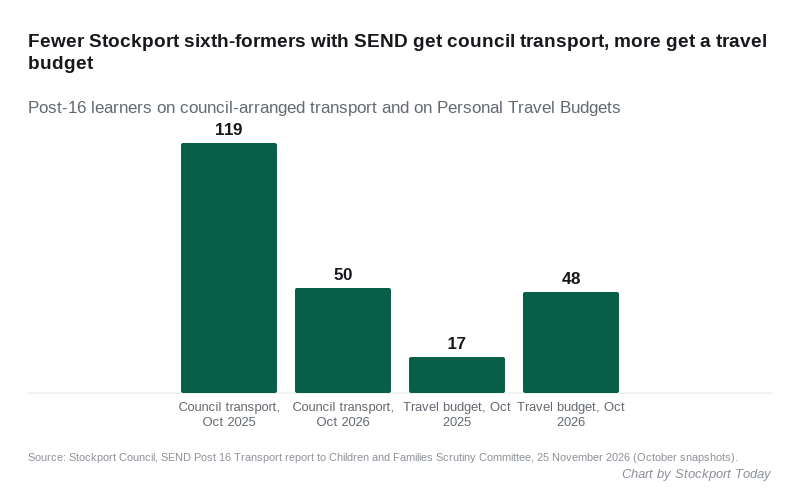
Council-arranged transport for Stockport sixth-formers with SEND fell from 119 to 50 after a new policy. Travel budgets rose from 17 to 48. Savings fell short.
The number of Stockport sixth-formers with special educational needs who get council-arranged transport has fallen from 119 to 50 in a year. The drop follows a new post-16 travel policy that started in September. More families now get a Personal Travel Budget to arrange the journey themselves: 48, up from 17.
The figures are in a report to the Children and Families Scrutiny Committee, which meets on Wednesday 25 November. They compare October 2025 with October 2026.
Overview
- Council transport, post-16: 50 learners, down from 119, on 31 routes, down from 69
- Travel budgets, post-16: 48 learners, up from 17
- Forecast cost of post-16 council transport: £554,380, down from £1,145,816
- Savings target: £750,000, which the report says was not reached
- No new changes proposed: the report is an update and asks councillors only to note it
What changed in September
The Cabinet approved the revised policy in February 2026. Families of young people moving into Years 12, 13 and 14 had to reapply for travel help, even if they were staying at the same school or college.
Each application is now assessed on whether the journey can be managed through:
- public transport concessions
- help from the school or college
- family or community support
- independent travel training
- a Personal Travel Budget
Council-arranged taxis and minibuses are still provided where an assessment finds they are needed. The policy keeps them for young people with the most complex needs, for example someone who needs an adapted vehicle and healthcare on the journey.
A travel budget is worked out at 41p a mile for two return journeys on each day the young person attends, plus a yearly lump sum of £703.73. The report is clear that it is “a contribution towards family-led travel”, not a refund of whatever the family spends.
It also says parents’ work commitments “do not, on their own, establish entitlement” to council transport.
The numbers in full
| Measure | October 2025 | October 2026 |
|---|---|---|
| Post-16 learners on council transport | 119 | 50 |
| Post-16 council transport routes | 69 | 31 |
| Post-16 forecast spending | £1,145,816 | £554,380 |
| Post-16 learners on travel budgets | 17 | 48 |
| Post-19 learners on council transport | 60 | 52 |
| Post-19 forecast spending | £723,301 | £793,042 |
The report warns that these are two snapshots of different groups. Some young people have left education and others have joined. The figures “do not show how many individuals moved from commissioned transport to a personal budget”.
Where the money went
Forecast spending on post-16 council transport fell by £591,436. Post-19 spending rose by £69,741, so the net fall was £521,695 before the extra cost of travel budgets.
The report says the post-16 changes “have been mostly successful” but did not reach the £750,000 saving attached to them. A further £667,000 saving was pinned on encouraging travel budgets for all ages. That has produced no savings beyond “minor cost avoidance”, the report says.
Pressure is growing on transport for younger children too. Between October 2025 and October 2026, council transport for under-16s grew from 865 to 933 children and from 175 to 217 routes, with forecast spending up £938,481. In all, 1,238 people now get travel help, against 1,068 in October 2024.
What it means for you
If your child is moving into sixth form or college, you will need to apply for travel help under the new policy, and the council will assess what support it considers necessary. If you disagree with the decision or the help offered, you can ask for a review through the council’s two-stage transport appeal process. The second stage is heard by an independent panel. A separate complaints process covers how an application was handled.
Officers say they will look at attendance alongside the transport figures. The report says they are “not proposing a return to routinely commissioned post-16 transport”.
Have your say