
Stockport Council wants every parking charge reviewed each year in line with CPI, with new prices each September from 2027. Cabinet decides on 8 December.
Every council parking charge in Stockport would be reviewed each year in line with inflation under plans going to the council’s Cabinet next month. New prices would take effect each September, starting in September 2027.
The proposal covers on-street bays and council car parks in the town centre, the district centres and the country parks. Parking permits are not included and would be considered separately. It is set out in a report to the Communities and Transport Scrutiny Committee, which meets on Monday 23 November. Cabinet is asked to approve it on Tuesday 8 December.
Overview
- Charges would be reviewed every year against the Consumer Prices Index (CPI).
- Revised prices would start on 1 September each year, from September 2027.
- Prices would stay in 10p steps, so a review will not always change the price.
- Council parking took £3,225,384 in fees from January to the end of September 2026.
- The RingGo contract for paying by phone ends on 9 February 2027.
How the yearly rise would work
The council would apply CPI to an underlying “CPI-adjusted value” for each tariff, then round it to the nearest 10p. The rounded figure is what drivers would pay. Halfway values would round up.
Because the inflation is added to the unrounded value, the price on the machine would not move every year. The report gives an illustration using a £1.50 tariff:
| Year | Price charged | CPI-adjusted value | New price |
|---|---|---|---|
| 1 | £1.50 | £1.53 | £1.50 |
| 2 | £1.50 | £1.57 | £1.60 |
| 3 | £1.60 | £1.60 | £1.60 |
| 4 | £1.60 | £1.63 | £1.60 |
The report says the table is for illustration only. It also says the rounding “may produce increases above CPI, particularly for lower tariffs”. A 10p step on a 50p charge is a 20% rise. The council says each year’s review would show the actual percentage increase on every tariff before it is approved.
The CPI rate to be used, and what happens if inflation is zero or negative, would be confirmed at each annual review. Legally, on-street charges cannot be raised to make a surplus for other spending. The report says the framework should keep the option to hold or cut a tariff “rather than require an automatic annual increase”.
The council’s argument is that small yearly reviews are better than large jumps after long freezes. It points out that most of its pay machines take only coins, and none smaller than 10p.
Where the money comes from
Parking fees brought in £3,225,384 between January and the end of September 2026. Car parks took £2,844,011 of that, about 88%. On-street bays took £381,373.
The Merseyway and Redrock car park is by far the biggest earner, at £1,208,659 in those nine months. That is more than five times the £214,023 taken at Stopford House, the next biggest.
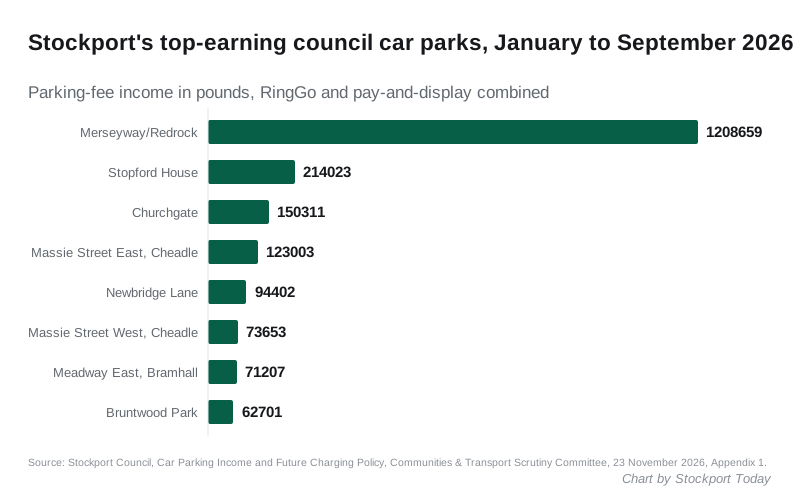
Outside the town centre, the busiest car parks by income were:
- Massie Street East, Cheadle: £123,003
- Massie Street West, Cheadle: £73,653
- Meadway East, Bramhall: £71,207
- Bruntwood Park: £62,701
- Chadwick Street, Marple: £49,931
- Etherow Country Park: £48,682
Income from on-street parking and penalty notices pays for running enforcement and on-street parking. Car park income goes towards the parking service, maintaining car parks, and highways maintenance and traffic management.
Paying by phone after February
The council has used RingGo for phone payments since 2012. That contract ends on 9 February 2027. The report says the current terms are “highly unlikely to be replicated in the current market”.
RingGo handled £3,401,549 of payments, including VAT, between October 2025 and September 2026. July 2026 was the busiest month, at £356,235.
Councillors are being told about the government’s National Parking Platform. It lets drivers choose between several parking apps instead of being tied to one. The report gives illustrative running costs of £65,000 to £78,000 a year, but says these are not a forecast. App providers can add their own convenience fees on top.
No decision on a payment provider is being asked for yet. The report says drivers will still be able to pay in cash. Most existing machines cannot take cards, and replacing them all for that reason alone is “not currently considered proportionate”.
What it means for you
Nothing changes now. The current council tariffs stay as they are until at least September 2027.
If Cabinet approves the policy on 8 December, prices would be worked out each spring and published over the summer. The new charges would apply from 1 September. Any change still needs the legal notices that let people object.
If you pay with the RingGo app, watch for a change of provider or app in early 2027. The council has not yet said what will replace the contract.
Councillors on the scrutiny committee will comment on the plan on Monday 23 November at 6pm. The meeting is public, and the papers are on the council’s meetings site.
Have your say