
From 31 October, Stockport councillors lose the power to call in planning applications, and objections alone will no longer force a committee hearing.
From 31 October, a Stockport councillor will no longer be able to pull a planning application in front of a committee. Nor will the number of objections a scheme attracts. Both of those triggers disappear under new national rules, and the council has to rewrite its constitution to match.
Cabinet is asked to approve those changes on Tuesday 15 September (agenda). The full Council Meeting signs them off on 1 October.
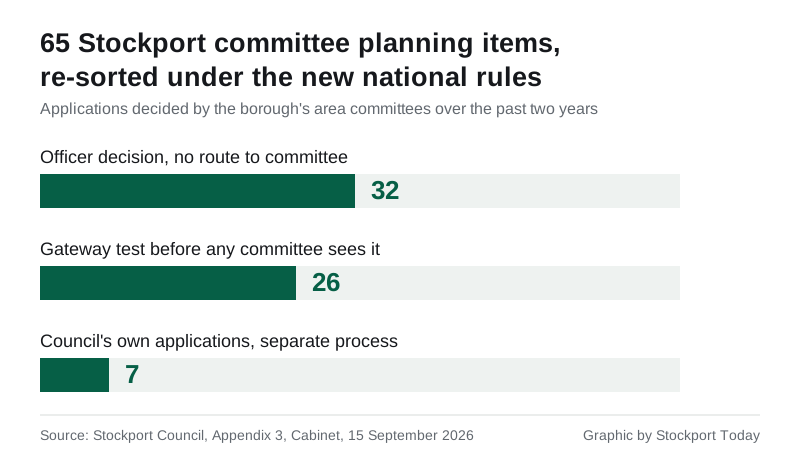
The council has published its own measure of the effect. Officers went back through the 65 planning applications that reached Stockport’s seven area committees over the past two years and sorted them under the new rules:
- 32 would have been decided by an officer, with no route to a committee at all
- 26 would face a new “gateway test” before any committee could see them
- 7 were the council’s own applications, which follow a separate process
That table is Appendix 3 to the report going to Cabinet (Stockport Council, Appendix 3).
What the new rules do
The changes come from the Town and Country Planning (Discharge of Local Planning Authority Functions) (England) Regulations 2026, made under the Planning and Infrastructure Act 2025. They come into force on 31 October 2026 and the council says they will apply immediately to every application still undecided on that date.
The regulations split applications in two.
Schedule 1 must be decided by an officer, in all circumstances. It covers householder applications, minor residential schemes of up to 10 homes, minor commercial development, permission in principle, lawful development certificates, non-material amendments, discharge of conditions and reserved matters on smaller outline permissions (Stockport Council, Appendix 2).
Schedule 2 is everything else, and it also goes to an officer unless two named people agree to send it to committee.
Those two are a “nominated member” and a “nominated officer”. In Stockport the report proposes the Chair of the Planning and Highways Regulation Committee as the member, deputised by the Vice-Chair, and the Chief Planning Officer as the officer, deputised by the Head of Development Management. They will sit fortnightly, and their decisions will be published as a fortnightly list.
To refer a scheme, they must agree that it raises either a significant planning matter, or an economic, social or environmental issue of significance to the local area. If they cannot agree, the regulations require the application to be decided by an officer.
What Stockport loses
The report is blunt about the two triggers that go (Stockport Council report):
- Member call-in ends. At present two or more councillors can call an application up to an area committee or to the main committee, provided they give a planning reason. That will no longer be possible at either level.
- Objections stop counting as a trigger. At present a scheme that is not fully delegated and attracts six or more objections goes to committee if officers recommend approval. Six or more letters of support do the same when officers recommend refusal. Neither will “in itself” send an application to committee again.
Area committees keep a voice but lose the vote. Schemes that pass the gateway test go to the area committee first, which can comment and can still ask for a site visit, and its views are then written into the report for the Planning and Highways Regulation Committee. What it cannot do is decide anything.
The regulations also cap a planning committee at 13 members. Stockport’s main committee already has exactly 13, so no seats are lost there.
The kinds of scheme now going to officers
Appendix 3 lists every case by reference. Among the applications that reached an area committee in the past two years and would now be fully delegated:
- a 16-bedroom house in multiple occupation at Sandy Lane, Romiley (DC/091310)
- a conversion to a seven-bedroom HMO on Northgate Road, Edgeley (DC/094341)
- an eight-bedroom HMO on Station Road, North Reddish (DC/094897)
- a drive-thru coffee shop on Manchester Road, Heaton Norris (DC/091228)
- demolition of a bungalow for four houses on Cheadle Road, Cheadle Hulme (DC/087656)
- eight houses on the kennels site at Blossoms Lane, Woodford (DC/088660)
That matters for one change Stockport is making at the same time. Cabinet is also being asked on Tuesday to bring in an Article 4 direction on HMOs, which would force landlords to apply for planning permission to convert a house into a small shared home. In the council’s own table, every recent HMO conversion is classed as Schedule 1, so those new applications would be officer decisions.
Bigger schemes still have a route. The Lidl at Cheadle Heath (DC/087761), 76 affordable homes off Wilmslow Road in Heald Green (DC/088902) and the Daw Bank bus depot (DC/097900) are all classed as gateway cases. The council’s own school rebuilds at Bramhall High and Moorfield Primary sit in the third group, the “own interest” applications made by the authority, its members or its officers, which the nominated member and officer can refer to committee without applying the gateway test.
What it means for you
- Comment early, and comment on planning grounds. The consultation window on the Public Access portal is now the main point where a resident can influence a small scheme. Design, traffic, parking, overlooking and amenity count. A petition will not move a decision to a public meeting.
- For a larger scheme, the decision to hold a hearing rests with two people. Watch the fortnightly referral list the council has promised to publish, and ask your ward councillor to make the case to the committee chair before it is taken.
- If you want to speak, the venue changes. Public speaking moves from the area committee to the Planning and Highways Regulation Committee, so that people address the councillors who actually decide. The report proposes keeping three minutes each for one speaker for and one against, and adding a requirement to register in advance rather than turning up on the night.
- Nothing changes before 31 October. Until then the current scheme of delegation, including member call-in, still applies.
The report went to the Constitution Working Party on 24 August, to the Corporate, Resource Management and Governance Scrutiny Committee on 1 September and to all seven area committees in the week beginning 7 September. After Cabinet on Tuesday it goes to the Planning and Highways Regulation Committee on 24 September and to the Council Meeting on 1 October. Cabinet meets at 6pm at Fred Perry House and is webcast.
More on how development is decided locally is on our Stockport planning news page, and the borough’s Local Plan consultation opens on 23 September.
Frequently asked questions
When do the new planning rules start in Stockport?
31 October 2026. The council says the changes take effect immediately on that date and apply to every application still undecided.
Can a Stockport councillor still call in a planning application?
No. From 31 October the call-in by two or more members, at an area committee or at the Planning and Highways Regulation Committee, no longer exists.
Do objections still send an application to a planning committee?
No. The current trigger of six or more objections where officers recommend approval goes, as does the equivalent trigger for letters of support. The number of representations will not, in itself, take an application to committee.
What is the gateway test?
The test the nominated member and nominated officer apply to Schedule 2 applications. They can refer one to committee only if they agree it raises a significant planning matter, or an economic, social or environmental issue of significance to the local area. If they do not agree, an officer decides it.
Can I still speak about an application at a public meeting?
Only on the applications that reach the Planning and Highways Regulation Committee, and the report proposes that speaking moves to that committee rather than the area committee. Three minutes each is proposed for one speaker for and one against, with registration in advance.
Sources
- Planning Committee Reforms and National Scheme of Delegation Implementation, report to Cabinet, 15 September 2026 (Stockport Council)
- Appendix 2: Schedule 1 and Schedule 2 and Appendix 3: comparison table of applications over the last 2 years
- Cabinet agenda, 15 September 2026
- The Town and Country Planning (Discharge of Local Planning Authority Functions) (England) Regulations 2026, SI 2026/854 (legislation.gov.uk)
All figures were checked against the linked council and legislation.gov.uk sources on 14 September 2026. The constitutional changes are subject to Cabinet on 15 September and the Council Meeting on 1 October; the 31 October start date is set by the regulations.
Have your say